

average cost for electrical panel upgrade: what actually drives the price
by Aayush Patel on Jul 29, 2026
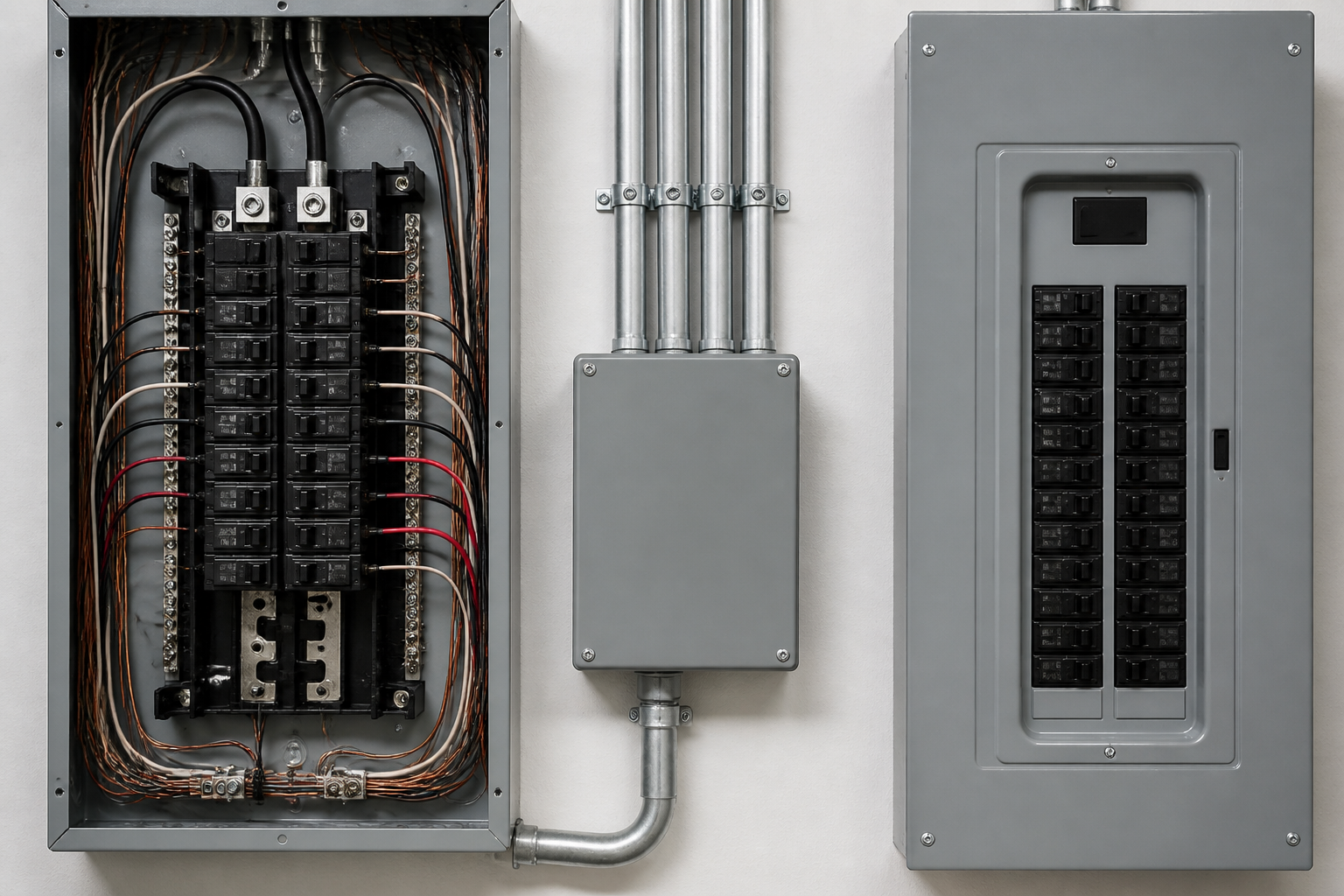
average cost for electrical panel upgrade: what actually drives the price
If you’re researching the average cost for electrical panel upgrade, you’ll quickly find broad ranges that aren’t very useful for planning. Real project totals depend on a handful of concrete details at your property: capacity needs, panel location and accessibility, feeder and grounding condition, service upgrades, and permit scope. This guide breaks those drivers down so you can build a realistic, line-item view with your electrician and avoid surprises on installation day.
What counts as an electrical panel upgrade
“Panel upgrade” is an umbrella term. Clarifying which of these applies to your project makes every cost conversation more precise:
- Main service panel replacement (like-for-like capacity) in the same location.
- Main service panel replacement with capacity increase (for example, preparing for EV charging or major appliances).
- Service equipment upgrade that may include meter base, service riser or lateral conductors, main disconnect, and grounding/bonding adjustments.
- Subpanel addition or replacement to expand circuit spaces without altering the utility service size.
- Panel relocation due to clearance, moisture, or workspace issues.
Each scenario changes the scope of materials, labor time, and coordination with the utility and inspectors—key levers behind your total outlay.
The core cost drivers
Focus on these drivers when estimating. They’re the factors that consistently move a quote up or down:
-
Amperage and spaces required.
Higher main breaker amperage and more breaker spaces typically mean heavier-duty equipment and potentially larger conductors. If you’re planning for future loads—EV charger, heat pump, hot tub—size for that now to avoid rework later.
-
Feeder, service conductors, and meter base condition.
If existing conductors are undersized or insulation is brittle, replacement becomes part of the scope. Likewise, outdated meter bases or service entrance hardware often need upgrades during a panel replacement.
-
Grounding and bonding.
Expect verification or upgrades to grounding electrodes, bonding jumpers, and water/gas bonding where applicable. Bringing these to current standards is both a safety and inspection consideration.
-
Panel location and accessibility.
Clear working space, dry location, and solid mounting surface trim labor time. Tight closets, exterior walls, or finishes that require careful removal/restoration add effort.
-
Relocation and labeling.
Moving a panel, rerouting branch circuits, and producing accurate circuit directories take additional hours. Clean labeling and documentation improve future serviceability.
-
Permits and inspection coordination.
Most panel upgrades involve permits and at least one inspection. The administrative time and any required utility coordination (like planned shutoffs) are part of project logistics.
-
Arc-fault and ground-fault protection strategy.
Depending on your configuration, protection can be integrated at the breaker level or out at the device. The chosen approach affects equipment selection and project time.
-
Finish work and restoration.
Drywall patches, paint touch-ups, or exterior sealing around enclosures add minor but real costs. If a panel is recessed or flush-mounted, factor in extra carpentry or patching.
How to build a reliable estimate without guessing
Instead of chasing averages, use a simple, verifiable process at your site. Bring these checks to a walkthrough with your electrician:
- Map your loads and future plans. List current large loads (HVAC, range, dryer, water heater) plus planned additions (EV charger, hot tub, workshop tools). Your load roadmap informs the target amperage and breaker count.
- Photograph everything. Capture the existing panel interior and exterior, the meter base, service riser or lateral entry, visible grounding electrodes, and utility drop or conduit routes. Photos help catch hidden scope items early.
- Measure clearances. Note ceiling height, side-to-side clearance, and workspace depth in front of the panel. Tight clearances or obstructions can trigger relocation or mounting adjustments.
- Identify branch circuits that may need AFCI/GFCI changes. Bedrooms, living areas, kitchens, baths, outdoors, garages—protection methods vary by configuration. Clarify where protection will live (breaker vs device) to avoid duplicate costs.
- Confirm grounding and bonding path. Verify ground rods or other electrodes, water/gas bonding where applicable, and conductor sizes. If anything is missing or deteriorated, add it to the scope now.
- Decide on relocation early. If the current location is damp, cramped, or not ideal for maintenance, evaluate relocation before ordering equipment. Rerouting conductors is a major cost lever.
After the walkthrough, request a written, line-item scope that separates equipment, labor, permits, utility coordination, protection devices, grounding/bonding, and finish work. That transparency makes it easier to compare proposals on equal footing.
Line items that shape your final number
Expect your proposal to include a subset of the following. Even if your project is straightforward, scanning this list helps ensure nothing is overlooked:
- Main panel enclosure and bus rating sized to your target amperage.
- Main breaker and any required service disconnect equipment.
- Branch breakers (standard, AFCI, GFCI, or dual-function where applicable).
- Feeder or service conductors, lugs, and terminations if upsizing or replacing degraded wiring.
- Meter base or meter socket hardware if replacement is warranted.
- Grounding electrode conductors, rods or other electrodes, and bonding jumpers.
- Conduit, connectors, clamps, and weatherproofing components for exterior runs.
- Labeling materials and updated circuit directory.
- Permit fees and inspection scheduling/attendance.
- Utility coordination for shutoff/turn-on or temporary power arrangements.
- Wall, siding, or finish repairs related to panel changeout or relocation.
Common scenarios and why they cost differently
While no two projects are identical, these patterns explain why quotes for “the same job” can differ:
- Like-for-like replacement in a compliant location. Minimal conductor changes, straightforward swap, and quick inspection usually result in less labor and fewer materials.
- Capacity increase without relocation. Larger conductors, upgraded main breaker, and possible meter base updates increase both materials and installation time.
- Relocation to meet workspace or moisture requirements. Rerouting many branch circuits and repairing finished surfaces significantly adds labor.
- Service equipment overhaul. When the riser, weatherhead or lateral components, and meter base all need attention, costs reflect a near “from-service-entrance-to-bus” refresh.
- Subpanel addition for circuit space. Often more economical than changing the main service if total load is acceptable, but still requires proper feeder sizing and protection.
Questions to ask before you approve a quote
Use these questions to clarify scope and reduce change orders:
- What is the calculated target amperage based on my current and planned loads?
- What grounding and bonding improvements are included?
- Where will AFCI/GFCI protection be implemented—at the breaker or device—and for which circuits?
- Is relocation recommended? If so, which circuits will be extended, and how will finishes be restored?
- What permits and inspections are required, and who handles scheduling?
- How long will power be off, and is utility coordination needed?
- What is excluded from this quote that could add cost later?
Budgeting checklist you can complete in 30 minutes
Run through this compact checklist to get from “average cost” to a tailored, verifiable estimate:
- Document appliance and system loads today; add expected near-term upgrades (EV, HVAC, workshop).
- Count your needed breaker spaces, including spares for growth.
- Take clear photos of panel interior, exterior, meter base, service entry, and grounding points.
- Measure panel workspace and note any obstructions or moisture issues.
- Decide whether relocation is preferred or required based on accessibility and maintenance.
- Request a line-item quote split into equipment, labor, permits/inspection, utility coordination, protection devices, grounding/bonding, and finish work.
- Ask for alternatives: same-day vs. staged work, protection at breakers vs. devices, or subpanel vs. main upgrade where load allows.
FAQs
Does an electrical panel upgrade always require increasing amperage?
No. Many upgrades replace aging equipment at the same amperage to improve reliability, space for new breakers, or to address safety and maintenance concerns. Amperage increases are typically driven by added loads like EV chargers, electrified heating, or new shop equipment.
Is a subpanel a cheaper alternative to a full service upgrade?
Sometimes. If your total load is already well-supported by the main service, a subpanel can add circuit spaces without changing the service size. If the load calculation shows you’re near the limit, a main service upgrade is the more appropriate path.
What adds unexpected cost late in a panel project?
Common late additions include deteriorated service conductors discovered during demolition, insufficient grounding systems, the need for relocation to meet workspace clearances, and finish repairs that weren’t scoped. Detailed photos and a pre-job walkthrough help surface these earlier.
Where to learn more and compare approaches
If you want deeper, scenario-based reading, these resources explore scope choices and budgeting frameworks:
- Cost to replace electrical panel guide 2026 – a structured overview of replacement considerations and planning steps.
- Cost to replace electrical panel 2026 guide – complementary angles on estimating, including common scope variations.
- Additional electrical upgrade reading – a topical reference point for readers comparing upgrade approaches.
Note: Electrical work involves safety-critical systems. This article is for general information only and is not professional advice. For code compliance and specific design decisions, consult a qualified, licensed electrician and your local authority having jurisdiction.
Next step


