


Commercial lighting installation is the end-to-end design, wiring, and commissioning of lighting systems for workplaces, retail, hospitality, and industrial sites. Done correctly, it lowers energy use, improves safety, and elevates the customer experience. From our Kingston base at 937 Gallaher Rd, Alpha9 Electric delivers compliant, high‑performance installs across Tennessee.
By Aayush Patel, CEO — Alpha9 Electric
Last updated: June 20, 2026
Quick Summary
This guide shows how to plan, design, install, and maintain commercial lighting for safer, brighter, and more efficient spaces. You’ll get step-by-step workflows, fixture options, lighting control strategies, code notes, checklists, and Tennessee-ready examples, plus internal resources to speed your next project in Kingston and across Roane County.
- What you’ll learn: lighting concepts, design steps, fixture types, controls, safety, and commissioning.
- Who it’s for: facility managers, business owners, GCs, and multi-site operators in Tennessee.
- Outcomes: lower utility bills, better visibility, stronger brand presentation, and fewer maintenance headaches.
- Use cases: offices, retail, restaurants, hotels, gas stations, warehouses, and manufacturing.
- Next step: schedule a walkthrough with our licensed electricians in Kingston.
- Table of contents
- What is commercial lighting installation?
- Why it matters in Kingston and Roane County
- How installation works (step-by-step)
- Types of lighting and approaches
- Best practices that prevent rework
- Tools, standards, and resources
- Case studies and Tennessee examples
- FAQ
- Key takeaways
- Conclusion & next steps
Local considerations for 937 Gallaher Rd
- Plan for mixed daylight and seasonal cloud cover in Roane County; tune sensor settings and schedules to avoid glare or dark spots as daylight shifts.
- Holiday and football season traffic can spike retail hours; add flexible scenes so staff can boost light levels quickly without rewiring.
- Coordinate with our team for inspection timelines in Kingston; we routinely align installs with tenant buildouts to keep openings on schedule.
What Is Commercial Lighting Installation?
Commercial lighting installation is the professional design, wiring, mounting, and commissioning of luminaires and controls in nonresidential spaces. The objective is safe, code‑compliant illumination that supports work, sales, and safety while minimizing energy and maintenance through LEDs, sensors, and smart controls.
In practice, it covers everything from photometrics and fixture selection to branch-circuit wiring, panel schedules, controls programming, and final punch lists. Our crews integrate lighting with power, life safety, and low-voltage so the whole system works smoothly.
Core components
- Luminaires: troffers, panels, strips, downlights, high-bays, wall packs, poles, decorative pendants.
- Controls: occupancy/vacancy sensors, daylight harvesting, time scheduling, dimming (0–10V, DALI), scene control.
- Power and wiring: circuits, switching, emergency egress, labeling, and as-builts.
- Documentation: submittals, cut sheets, one-lines, and commissioning reports.
When we deliver a complete commercial lighting installation, you receive digital as-builts, warranty info, and a simple playbook for your staff.
Why It Matters in Kingston and Roane County
For businesses near 937 Gallaher Rd and across Roane County, modern commercial lighting improves safety, merchandising, and energy performance. LEDs, sensors, and smart scenes cut waste, elevate curb appeal, and support compliance—key for offices, retailers, hotels, gas stations, and plants operating on tight timelines.
Lighting drives first impressions and worker comfort. We see productivity gains when glare is reduced and task areas reach recommended light levels. Exterior upgrades also deter loitering and improve camera clarity for integrated CCTV.
Benefits you can measure
- Energy: LED retrofits often reduce lighting kWh noticeably compared to legacy sources.
- Safety: brighter egress paths, uniform parking lots, and code-aligned emergency lighting.
- Brand: consistent color temperature and CRI that make products and finishes pop.
- Operations: fewer relamps, simplified maintenance, and sensor-driven scheduling.
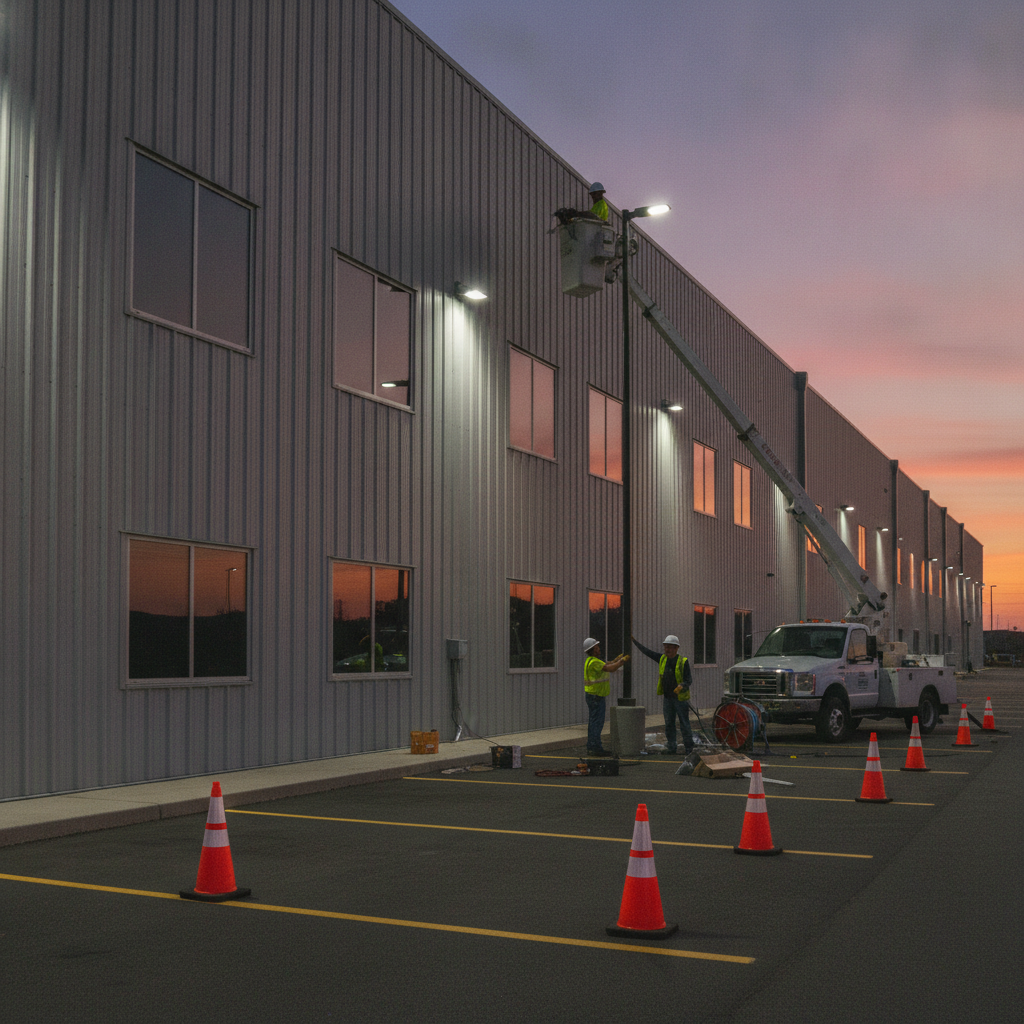
In our experience around Kingston, exterior pole LED upgrades can transform evening visibility almost overnight, improving both guest confidence and staff security.
How Commercial Lighting Installation Works (Step-by-Step)
A successful commercial lighting installation follows a structured path: assess spaces, design photometrics, select fixtures, plan wiring, install safely, program controls, and commission. Clear sequencing prevents change orders and ensures code compliance, warranty coverage, and on-time inspections.
Seven-step workflow
- Site assessment: document existing fixtures, ceiling types, voltage, controls, and daylight; note hazards and shutdown windows.
- Design & photometrics: set target illuminance by area (office, sales floor, kitchen, warehouse) and model layouts.
- Fixture & control selection: choose lumen packages, optics, CCT, sensors, and dimming protocols.
- Wiring plan & materials: circuit schedules, emergency egress, conduit/cable, labeling plan.
- Installation: safe lockout/tagout, mounting, wiring, and torque to spec; maintain clean ceilings and finished spaces.
- Programming: set sensor timeouts and daylight setpoints; define scenes for business hours and cleaning.
- Commissioning: verify levels, uniformity, emergency function, and deliver as-builts/warranty packets.

Process at a glance
| Phase | Owner | Key Deliverables | Notes |
|---|---|---|---|
| Assessment | Alpha9 + Client | Field notes, photos, utility data | Identify shutdown windows; confirm ceiling access |
| Design | Alpha9 | Layout, counts, controls map | Model target foot‑candles per area use |
| Procurement | Alpha9 | Approved submittals, lead times | Align deliveries with install phasing |
| Install | Alpha9 | Mounted/wired luminaires | Document circuit labels and as‑builts |
| Program | Alpha9 | Scenes, sensor setpoints | Test overrides and schedules |
| Commission | Alpha9 + Client | Punch list, O&M packets | Train staff; log warranty start |
For deeper planning tips, see our internal overview on electrical construction sequencing.
Types of Commercial Lighting and Approaches
Most projects blend ambient, task, and accent lighting using LED troffers/panels, downlights, strips, high‑bays, wall packs, and poles. Exterior safety, emergency egress, and signage complete the system. Controls—sensors, dimming, daylighting, scenes—tie it all together for efficiency and comfort.
Interior categories
- Office & education: recessed panels/troffers with low-glare optics, 3500–4000K, 0–10V dimming.
- Retail & restaurants: layered ambient + accent track or downlights; warm 3000–3500K for merchandise and finishes.
- Warehouses: high-bay LEDs with motion zoning; bright, uniform, low-maintenance.
- Kitchens & back-of-house: sealed fixtures, high CRI, durable lenses, and code-aligned emergency lighting.
Exterior and site
- Wall packs & canopies: secure perimeters and fueling areas with forward-throw optics.
- Parking lot poles: uniform coverage and good vertical illuminance for faces and license plates.
- Building accents: architectural grazing to elevate brand at entrances.
Control strategies
- Occupancy/vacancy sensors: trim waste in intermittently used spaces.
- Daylight harvesting: dim perimeter rows near windows to stabilize appearance and save energy.
- Scenes & schedules: one‑touch presets for open/close, cleaning, and overnight security levels.
If you’re curating a full fit-out, our Kingston lighting installation guide shows how these layers play together in real tenant spaces.
Best Practices That Prevent Rework
The fastest projects are planned tightly and documented clearly. Confirm ceiling conditions, model light levels, pre‑label circuits, and program controls before turnover. Protect warranty by following torque specs, honoring clearances, and logging serials—then train staff so your savings stick.
Design and documentation
- Gather utility bills and hours of operation to size controls and schedules.
- Map emergency egress and code-mandated pathways during layout.
- Standardize CCT/CRI by area to avoid patchwork color and shadow.
- Create a concise one-page control narrative for operators.
Installation discipline
- Use lockout/tagout and maintain clear floor paths to keep operations moving.
- Torque terminations to spec; loose connections cause early failures.
- Label panels, breakers, and fixtures; snap photos for the as-built binder.
- Stage materials floor-by-floor to reduce handling and downtime.
Commissioning and handoff
- Verify target foot‑candles and uniformity in representative zones.
- Set sensor timeouts and daylight setpoints; test overrides and scenes.
- Train managers on quick changes (e.g., busy weekends vs. cleaning crew).
- Log serials and warranty terms; share a simple maintenance calendar.
We codified many of these practices in our lighting installation primer and our commercial electrical services overview.
Tools, Standards, and Resources
Great outcomes blend proven tools with clear standards. Photometric software, reliable meters, and manufacturer submittals guide design and verification, while documented control narratives and O&M packets keep performance stable after turnover.
Field and design tools
- Photometric modeling to predict target levels and uniformity.
- Light meters and commissioning checklists to verify outcomes.
- Label printers and QR-coded as-builts for fast future service.
Documentation you’ll keep
- Approved fixture cut sheets and control risers.
- Panel schedules, circuit labeling maps, and emergency pathways.
- Warranty summaries with contact info and replacement procedures.
If you’re exploring vendor selection, this perspective on commercial lighting installation companies outlines key questions to ask about crews, warranties, and controls integration.
Case Studies and Tennessee Examples
Alpha9 Electric delivers commercial lighting across offices, retail, hospitality, fuel stations, warehouses, and plants. Our Tennessee portfolio shows quick wins—uniform lots, brighter sales floors, and back‑of‑house upgrades that reduce relamps—without disrupting daily operations.
Retail refresh
- Replaced aging troffers with low‑glare LED panels and added end‑of‑day scenes for stocking.
- Improved color rendering on merchandise while trimming wasted after-hours run time.
- Integrated lighting zones with existing CCTV to sharpen image clarity at entrances.
Fuel & convenience canopy
- Upgraded canopy and perimeter wall packs at a multi-brand fuel site.
- Result: brighter forecourt, better facial recognition for cameras, more uniform brand presentation from the road.
- Crews staged work to keep pumps open, coordinating with managers hourly.
Warehouse high-bay swap
- Converted legacy high-bays to sensor-zoned LEDs with clean, even coverage.
- Reduced ladder work and lamp changes; staff reported fewer shadowed aisles.
- Documented commissioning with photos, levels, and sensor settings for the facility binder.
Browse more examples on our project highlights and our commercial lighting article.
Need a fast, compliant install? Our licensed team designs, installs, and commissions lighting with integrated controls, CCTV, and access control when needed. Start with a quick walkthrough and a no‑obligation plan from our Kingston electricians.
Frequently Asked Questions
These quick answers address the most common questions we hear about commercial lighting installation—from timelines and disruptions to controls and maintenance. For site‑specific advice, book a walkthrough with our Kingston team.
What’s included in a commercial lighting installation?
It includes design and photometrics, fixture and control selection, wiring and mounting, programming, and commissioning. You’ll receive as‑builts, labeling, and warranty documentation. When needed, we coordinate with other trades and integrate security or low‑voltage systems.
How disruptive is the upgrade for an operating business?
We phase work to match business hours, often installing before open or after close. Clean staging, floor protection, and clear paths keep operations moving. For 24/7 facilities, we plan rolling shutdowns so no area is offline longer than necessary.
Do I need lighting controls if I’m already using LED fixtures?
Yes—controls deliver a second tier of savings and comfort. Sensors, daylight harvesting, and simple scenes reduce wasted run time, stabilize appearance through the day, and make after‑hours cleaning easier without manual switching.
What documentation should I expect at handoff?
Expect fixture cut sheets, panel schedules, a controls narrative with setpoints, as‑built drawings, and a warranty summary. We also provide photo documentation of labels and settings to simplify future service or expansions.
Can lighting integrate with CCTV or access control?
Yes. Coordinated exterior lighting improves camera clarity, and schedules can align with access control events. Alpha9 Electric provides integrated security options—CCTV, access control, and alarm tie‑ins—to create a cohesive system.
Key Takeaways
Plan tightly, document clearly, and commission thoroughly. Blend LEDs with controls, set consistent color and CRI, and label everything. Train staff so scenes and schedules stick—and your savings do, too.
- Commercial lighting installation is most effective when design, wiring, and controls are planned together.
- Prioritize safety, labeling, and documentation to protect warranties and make service fast.
- Use scenes and sensors to reduce wasted run time without hurting comfort or sales.
- Exterior uniformity boosts safety and improves CCTV clarity.
- Partner with a licensed, insured contractor that integrates power and low‑voltage.
Conclusion & Next Steps
The right lighting plan makes spaces safer, clearer, and more inviting while trimming waste. When you integrate LEDs with smart controls—and hand off solid documentation—you protect uptime and brand impact for years.
- Book a site walk with our licensed Kingston electricians.
- Review recent work on our project highlights.
- Skim our lighting installation guide for deeper planning tips.
Ready to brighten your space? Alpha9 Electric designs, installs, and maintains lighting for offices, retail, hotels, fuel sites, warehouses, and plants across Tennessee—backed by a 100% satisfaction guarantee.


