


Installing a GFCI outlet is the process of replacing a standard receptacle with a ground-fault circuit interrupter that trips within milliseconds when it senses a small current leak (about 5 mA), helping prevent electric shock. It’s vital in kitchens, bathrooms, garages, and outdoor areas. Alpha9 Solutions’ licensed electricians install and test GFCIs safely in the local area.
By Alpha9 Solutions — Trusted Electrical Experts
Last updated: June 9, 2026
Overview
A GFCI outlet monitors the balance between hot and neutral conductors and cuts power when it detects a ground fault, typically around 5 mA. Use it in wet or damp locations. This overview highlights where you need GFCIs, the tools required, a safe step-by-step installation, and quick troubleshooting tips.
Here’s what you’ll find in this complete guide and why it matters for home safety and compliance.
- What a GFCI outlet is and how it works
- Why GFCIs are required in kitchens, bathrooms, outdoors, and more
- Prerequisites to check before installing a GFCI outlet
- Step-by-step wiring with clear testing procedures
- Best practices, code-minded tips, and common mistakes to avoid
- Fast troubleshooting for nuisance trips, open grounds, or reversed line/load
Local considerations for your area
- Plan installations around seasonal moisture: bathrooms, garages, and outdoor receptacles face humidity and rain; prioritize GFCI protection where water is likely.
- Schedule work during low-usage hours to minimize downtime for kitchens or home offices; GFCI installs often require brief circuit shutdowns.
- Use weather-resistant (WR) and tamper-resistant (TR) GFCI receptacles outdoors and in family spaces for durability and child safety.
What is a GFCI outlet?
A GFCI outlet is a ground-fault circuit interrupter receptacle that shuts off power when it senses a tiny current leak to ground, typically near 5 mA. Its built-in test/reset mechanism protects people from shock hazards in wet or damp locations like bathrooms, kitchens, garages, basements, and outdoor areas.
A GFCI compares incoming and returning current on the hot and neutral conductors. If the difference exceeds its threshold, it trips. This “personnel protection” level is engineered to react far faster than a breaker—within fractions of a second. Modern GFCIs include self-test features, indicator LEDs, and trip memory.
Where do you need them? Kitchens, bathrooms, laundry areas, garages, basements, crawlspaces, boathouses, and outdoor receptacles are standard candidates. Weather-resistant (WR) and tamper-resistant (TR) versions extend longevity and safety. For circuits feeding multiple outlets, you may use the GFCI’s LOAD terminals to protect downstream receptacles.
If you want a broader safety foundation before diving in, our in-depth home electrical safety guide and practical household wiring guide set the context for safe DIY work.
Why installing GFCIs matters
Installing GFCI outlets reduces shock risk dramatically and aligns your home with modern electrical safety standards. Because most household shocks arise from ground faults near water, adding GFCIs in kitchens, bathrooms, outdoors, and garages is one of the highest‑impact upgrades you can make.
Shock incidents often involve small leakage currents that a standard breaker won’t detect. GFCIs monitor imbalance and trip around 5 mA, interrupting the fault path in milliseconds. That speed matters. It helps prevent serious injury where water increases conductivity—sinks, tubs, outdoor faucets, and utility sinks.
Beyond protection, GFCIs simplify code compliance in wet or damp areas. Using tamper‑resistant models adds another layer for families with children. For example, when Alpha9 Solutions hardens a garage circuit that also powers outdoor cameras, we specify WR/TR GFCI units with in‑use covers so outlets stay protected during rain.
To see how we approach broader safety alignment, visit our electrical installation best practices and our home electrical services overview.
How a GFCI works (in plain English)
A GFCI uses a tiny current transformer to compare hot and neutral flow. If even a ~5 mA difference appears—suggesting current is leaking to ground—the internal relay opens and cuts power. Pressing RESET restores power after the fault clears; pressing TEST simulates a fault to verify protection.
Think of it as a vigilant referee. It doesn’t wait for high current; it watches for mismatch. A hair dryer contacting water could divert just a few milliamps through a person—enough to be dangerous. The GFCI senses that imbalance instantly and trips to stop current flow through the unintended path.
Modern devices self‑test periodically. Some models lock out if internal electronics fail, preventing false assurance. Indicator lights communicate status: solid green for normal operation, amber/red for fault or end‑of‑life in many designs. Always confirm with the TEST button after installation and monthly thereafter.
For a deeper safety culture perspective, see our NEC and NFPA compliance overview.
Prerequisites: what to verify before installing a GFCI outlet
Before installing a GFCI, confirm the power is OFF, identify the LINE feed, check box fill and grounding, and verify circuit ampacity and wire gauge (e.g., 20 A circuits typically use 12 AWG). Labeling LINE vs. LOAD correctly prevents dangerous miswiring and nuisance trips.
- Shut off power: Turn off the correct breaker. Use a non-contact tester and a plug-in tester to confirm de-energized conductors.
- Identify LINE conductors: Determine which cable brings power from the panel. Cap and separate conductors, restore power briefly to test which pair is hot, then turn it OFF again.
- Check wire gauge and breaker size: 15 A circuits commonly use 14 AWG; 20 A circuits use 12 AWG. Match the GFCI rating to the circuit.
- Verify grounding: Ensure a bonding path exists via bare or green equipment grounding conductor or metal raceway.
- Assess box fill: Ensure there’s adequate cubic inches for conductors, device yoke, and pigtails; add an approved box extender if needed.
- Inspect environment: Use WR GFCIs outdoors or in damp sites; add an in‑use cover where cords may remain plugged in.
Alpha9 Solutions often adds an outdoor junction box for neat, weather‑tight terminations when protecting exterior outlets—an approach that also helps with wire concealment and long‑term durability.
Tools and materials you’ll need
You’ll need a GFCI receptacle (15 A or 20 A to match the circuit), wall plate, non-contact tester, plug-in tester, screwdriver set, wire stripper, needle-nose pliers, electrical tape, and pigtail leads. For outdoor installs, use WR/TR devices, in‑use covers, and weatherproof boxes.
- Safety: Voltage tester, insulated screwdriver, safety glasses, gloves.
- Hand tools: Combination screwdriver, wire stripper/cutter, pliers, torpedo level.
- Materials: GFCI receptacle (self-test preferred), matching wall plate, short pigtails, wirenuts, electrical tape.
- Outdoor/damp: WR/TR GFCI, gasketed in‑use cover, weatherproof box, corrosion‑resistant screws.
- Labels: “GFCI Protected” and “No Equipment Ground” stickers included with device if needed.
For complete project context, see our residential electrician guide and the hands‑on installation guide.
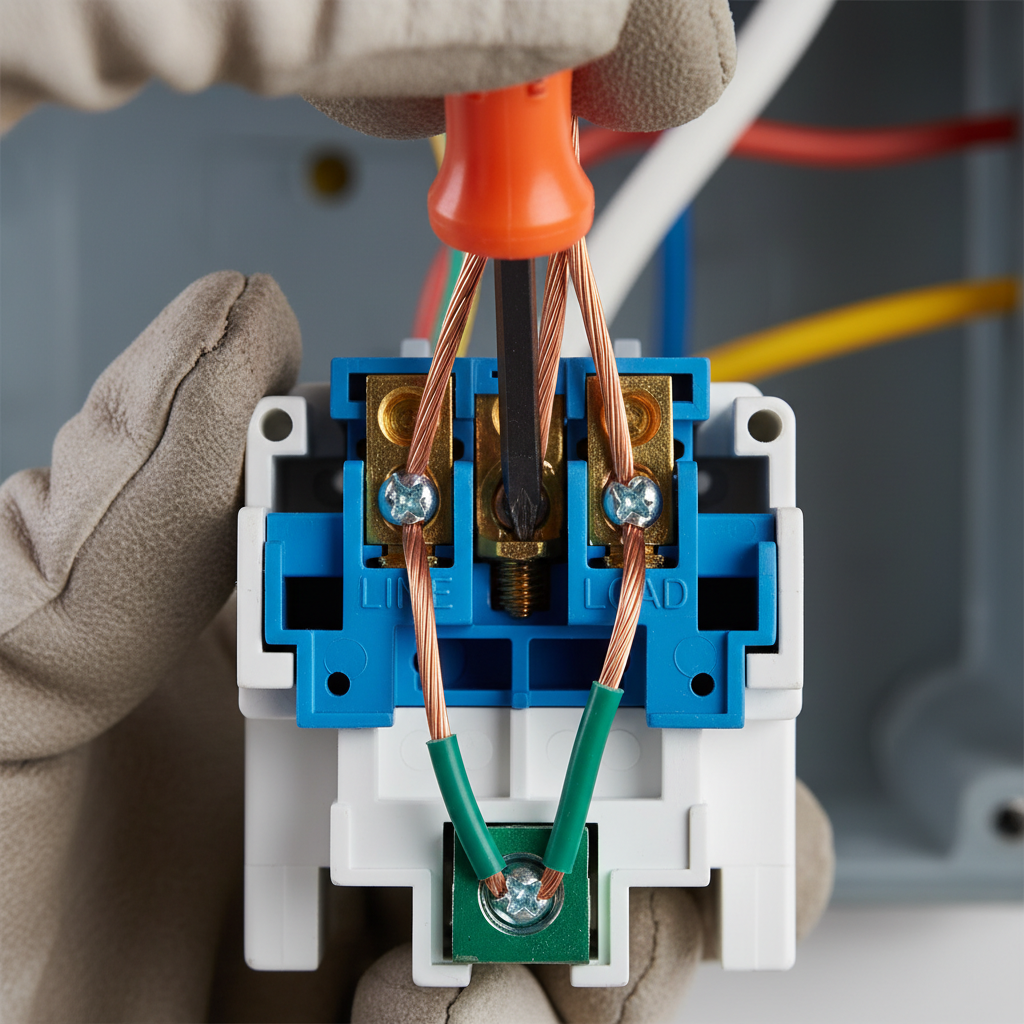
Step-by-step: installing a GFCI outlet
Turn off power, verify de‑energized conductors, identify the LINE feed, connect hot/neutral/ground correctly, cap LOAD unless protecting downstream, mount and level the device, restore power, then test with the built‑in TEST/RESET and a plug‑in GFCI tester. Label downstream outlets if using LOAD.
- Turn off power at the breaker. Confirm with a non‑contact tester and by plugging in a lamp or tester.
- Pull the receptacle and gently separate conductors. Photograph the existing wiring for reference.
- Identify LINE (panel feed). Restore power momentarily to find the hot pair; mark it. Turn power OFF again.
- Prepare conductors: Strip to manufacturer’s spec (often ~5/8 inch). Create pigtails for neutral and ground if needed.
- Connect ground to the green screw. Bond metal box if present.
- Connect LINE hot (usually black) to the brass LINE terminal; LINE neutral (white) to the silver LINE terminal.
- LOAD (optional): If protecting downstream outlets, connect hot/neutral to LOAD screws and apply included “GFCI Protected” labels to those outlets.
- Tuck wires carefully. Avoid sharp bends; maintain device depth and alignment.
- Mount, level, and install plate. Use a level for a clean finish.
- Restore power and press RESET.
- Test using the device TEST button and a plug‑in GFCI tester. Confirm proper wiring and trip behavior.
Note: If your branch circuit uses multi‑wire configurations (shared neutral), or if you’re unsure about box fill, call a licensed electrician. Alpha9 Solutions performs line/load diagnostics and labeling, and we can extend GFCI protection to outdoor outlets that power security lighting or camera power supplies.
Wiring options: line-only vs. load-protected
You can wire a GFCI as “line-only” to protect just that receptacle or use the “load” terminals to extend protection to downstream outlets. Line-only is simpler; load-protected can cover an entire run. Label all downstream points if you use load.
Choose the approach that fits your layout and maintenance preferences. Line‑only keeps troubleshooting localized; if a downstream outlet trips, you won’t need to hunt for a controlling GFCI. Load‑protected can reduce hardware count, which is handy in garages or outdoor runs, but label everything so future users know where to reset.
| Scenario | Recommended Method | Pros | Considerations |
|---|---|---|---|
| Single bathroom outlet | Line-only | Simple, local reset | No downstream coverage |
| Garage with multiple receptacles | Load-protected | Protects entire run | Must label downstream |
| Outdoor chain of outlets | Load-protected + WR | Full coverage outdoors | Use in‑use covers |
| Kitchen counter split circuits | Line-only per box | Avoid shared-neutral complexity | More devices to buy |
Testing and ongoing maintenance
Test GFCI outlets on installation and monthly: press TEST to trip, verify power is cut, then press RESET. Use a plug-in tester to confirm trip and wiring. Replace units that won’t reset, trip spontaneously without cause, or show failed self-test indicators.
- Initial verification: Use both the device button and a plug‑in tester. Confirm correct line/load usage via indicator lights.
- Monthly schedule: Press TEST/RESET to ensure the mechanism remains responsive. Many manufacturers recommend monthly checks.
- Environmental care: Keep outdoor GFCIs dry inside in‑use covers; check gaskets annually.
- Replacement triggers: Persistent failure to reset, cracked housing, or end‑of‑life indicators mean it’s time to replace.
Need broader help with a home electrical plan? Our electrical safety guide explains layered protection, from GFCIs and AFCIs to bonding and surge mitigation.

Troubleshooting: fast fixes for common GFCI issues
If a GFCI won’t reset, check power on LINE, correct reversed line/load, confirm neutral continuity, and inspect downstream devices for ground faults. For frequent trips, look for moisture, worn cords, or equipment leakage. Labeling and WR enclosures prevent many repeat problems.
- Won’t reset: Verify breaker is on and LINE is powered. If you connected to LOAD by mistake, move to LINE screws.
- Nuisance trips: Check for dampness in outdoor/in‑use covers; inspect appliance cords for damage; evaluate long runs for leakage.
- Open ground: Confirm ground continuity; bond metal box; add “No Equipment Ground” label if upgrading two‑wire circuits with GFCI protection.
- Shared neutral (MWBC): Avoid sharing a neutral on the load side unless the device and wiring method are approved for it; consider individual GFCIs line‑only.
- Downstream dead: If using LOAD, test each downstream receptacle; apply or replace “GFCI Protected” labels for clarity.
When Alpha9 Solutions outfits exterior outlets feeding security lighting or camera power supplies, we select WR receptacles and gasketed covers to eliminate moisture‑related trips. Our electricians also test insulation resistance when leakage is suspected.
Best practices for safe, neat installs
Match device rating to circuit ampacity, use WR/TR where needed, torque terminals to spec, and label downstream outlets. Maintain box fill limits, bond grounds securely, and test with both the device button and a plug-in tester for redundancy.
- Right device, right place: 15 A vs. 20 A, indoor vs. outdoor (WR), and TR for family spaces.
- Mechanical quality: Use a level, avoid over‑tightening plate screws, and ensure stable mounting.
- Electrical precision: Proper strip length, clockwise hook under terminal screw heads, correct polarity.
- Documentation: Record which downstream outlets are load‑protected; leave a note in the panel directory.
- Protection layers: Pair GFCIs with AFCIs where required for arc faults; add surge protection for sensitive electronics.
Explore more installation nuances in our electrical installation guide.
Circuit ratings, wire gauges, and receptacle choices
Coordinate breaker size, wire gauge, and GFCI rating. Typical 15 A circuits use 14 AWG conductors and 15 A receptacles; 20 A circuits use 12 AWG and 20 A receptacles. Match weather-resistant and tamper-resistant features to the location.
| Breaker | Wire Gauge (Copper) | Common Use | GFCI Receptacle | Notes |
|---|---|---|---|---|
| 15 A | 14 AWG | General lighting/outlets | 15 A GFCI | Indoor, TR where needed |
| 20 A | 12 AWG | Kitchens, garages | 20 A GFCI | WR/TR in damp/wet areas |
| 20 A (dedicated) | 12 AWG | Appliances, baths | 20 A GFCI | Consider load‑protection |
Mini case studies and real-world examples
These quick scenarios show how GFCIs reduce risk across common home projects. Each example reflects conditions we see often and how Alpha9 Solutions designs neat, durable installations that hold up to weather and daily use.
- Bathroom upgrade: Replaced a standard outlet with a 20 A WR/TR GFCI near the vanity; monthly test schedule added.
- Kitchen counter run: Installed line‑only GFCIs per box to avoid shared‑neutral load complexities across split circuits.
- Garage freezers: Used load‑protected GFCI at the first receptacle; labeled all downstream spots for quick resets.
- Outdoor holiday lighting: Added WR GFCI with gasketed in‑use cover; eliminated moisture trips after rain.
- Basement workshop: Converted the first receptacle to GFCI; protected downstream tool stations; added surge protection.
- Laundry zone: Upgraded to dedicated 20 A GFCI near the utility sink; used TR for family safety.
- Sump pump outlet: Evaluated leakage risk; installed WR GFCI with downstream labeling and regular test reminders.
- Patio camera power: Put WR GFCI in a weatherproof box; supplied a PoE injector on a protected outlet for outdoor IP camera gear.
- Boathouse receptacle: Deployed WR GFCI and stainless hardware; routine moisture inspection plan.
- Crawlspace maintenance: GFCI on service outlet for dehumidifier; emphasized cord inspection and drip loops.
- Rental turnover: Performed a GFCI audit across baths, kitchen, and exterior; replaced aged units and updated labels.
For a complete service perspective, see our residential electrician guide.
Alpha9 Solutions installs, labels, and tests GFCIs, including WR/TR outdoor setups with in‑use covers. We also tidy up junction boxes and add neat wire concealment where needed. Visit our electrical services page to get started.
Frequently Asked Questions
Homeowners ask about placement, testing, load wiring, and behavior during storms or high humidity. These concise answers address the most common GFCI questions so you can install confidently and maintain reliable protection over time.
Do all bathroom outlets need to be GFCI protected?
Yes—bathroom receptacles should have GFCI protection. You can use a GFCI receptacle at each location (line‑only) or protect multiple outlets via the load terminals from the first device. Label downstream outlets if you use the load method.
What’s the difference between line and load on a GFCI?
LINE is the feed from the panel; LOAD sends protection downstream. If you connect the feed to LOAD by mistake, the device won’t reset. When in doubt, cap LOAD and use line‑only to protect just that receptacle.
How often should I test a GFCI outlet?
Test on installation and monthly thereafter. Press TEST to trip and confirm power is cut, then press RESET to restore. A plug‑in GFCI tester adds extra assurance that wiring and trip behavior are correct.
Can I install a GFCI on a two‑wire circuit without ground?
Yes, a GFCI can provide shock protection on ungrounded circuits. Mark the receptacle with “No Equipment Ground” and “GFCI Protected” labels. Grounding is still recommended wherever feasible for equipment performance.
Key takeaways
Use GFCIs wherever water and electricity might meet, wire LINE and LOAD correctly, and verify protection with both device and plug-in tests. WR/TR devices and in‑use covers improve durability outdoors. Label downstream outlets clearly to simplify future troubleshooting.
- Install GFCIs in bathrooms, kitchens, outdoors, garages, and basements.
- Identify and wire the LINE feed correctly; cap LOAD unless protecting downstream.
- Test at install and monthly; replace units that fail to reset or self‑test.
- WR/TR and in‑use covers are essential for outdoor longevity.
Conclusion
Installing a GFCI outlet is one of the highest‑value safety upgrades you can do. With proper tools, correct LINE/LOAD wiring, and routine testing, you’ll reduce shock risk across kitchens, baths, and outdoor spaces. When in doubt, call a licensed electrician.
Whether you’re tackling one bathroom receptacle or auditing every wet‑location outlet, the steps in this guide keep work safe and neat. If you’d like a professional to handle testing, labels, and outdoor weatherproofing, Alpha9 Solutions is ready to help. Explore our services and book a quick assessment on our electrical services page.

New Construction Wiring: Get Safe Power in 2026 Homes

Industrial Security Camera Setup: Avoid Costly Errors in 2026

