


Three-phase electric power is an AC system using three 120°-shifted waveforms to deliver near-constant power to motors and large loads. It supports higher power density and lower losses than single-phase, which is why our licensed electricians at Alpha9 Solutions design and service three-phase upgrades in the local area for safer, more reliable operations.
By Aayush Patel, CEO — Alpha9 Solutions
Last updated: 2026-06-08
Above the Fold: Hook, Overview, and Quick TOC
Three-phase power delivers smoother motor torque, higher efficiency, and room to grow compared to single-phase. If you run HVAC, pumps, compressors, or production gear, the upgrade can stabilize voltage, reduce nuisance trips, and simplify expansion. Use this guide to plan a safe, code-ready path with a licensed team.
Most facilities outgrow single-phase once equipment becomes the constraint. This complete guide explains what three-phase is, why it matters, how it works, and how Alpha9 Solutions approaches safe, efficient upgrades without disrupting your schedule.
- Understand three-phase fundamentals in plain English
- Compare wye (Y) and delta (Δ) services with common voltages
- See design, safety, and maintenance best practices
- Map tools and planning resources for predictable upgrades
- Review quick case studies and answers to common questions
- Quick Summary
- What Is Three-Phase Electric Power?
- Why Three-Phase Matters
- How Three-Phase Works
- Configurations, Voltages, and Approaches
- Best Practices
- Tools and Resources
- Mini Case Studies
- Frequently Asked Questions
- Conclusion and Next Steps
Quick Summary
Three-phase electric power uses three equal voltages, each 120° apart, to provide nearly constant power. This improves motor performance, reduces line losses, and increases capacity. For many facilities, upgrading to three-phase unlocks safer, more reliable electrical and low-voltage systems with clear headroom for growth.
In our experience integrating electrical and security camera systems, three-phase service is the backbone that keeps large HVAC, compressors, and process motors running smoothly while leaving capacity for PoE switches, NVR racks, and lighting. A thoughtful plan avoids downtime, improves safety labeling, and simplifies future tenant or equipment additions.
- Smoother torque and fewer nuisance trips for motors and drives
- Higher efficiency and smaller conductors for the same load
- Common building services: 208/120 V wye and 480/277 V wye
- Flexible distribution with step-down transformers as needed
- Better platform for low-voltage reliability (PoE, NVR, networking)
What Is Three-Phase Electric Power?
Three-phase electric power is an AC system with three identical voltages phase-shifted by 120°. The symmetry produces near-constant power and smooth motor torque, enabling efficient transmission, smaller conductors, and better stability than single-phase for large commercial and industrial loads.
Think of three runners spaced 120° around a track. As one slows, another is surging. That overlap keeps the finish-line pace steady. In electrical terms, the “finish line” is your equipment terminals—motors, variable frequency drives (VFDs), HVAC units, and UPS inputs—seeing a steadier flow of real power.
-
Key properties
- 120° phase separation among the three sinusoidal voltages
- Line-to-line voltage equals √3 (≈1.732) times line-to-neutral in wye
- Balanced loading reduces neutral current and heating
- Common topologies: wye (Y) with neutral, delta (Δ) without neutral
-
Where it shows up
- Rooftop HVAC, elevators, process motors, air compressors
- Large kitchen exhaust, mixers, and refrigeration racks
- Central UPS, server rooms, and building pumps
Our licensed electricians regularly design, install, and label three-phase panels, feeders, and transformers, integrating them with low-voltage racks that power IP cameras, NVRs, and access control—so your critical systems ride on a clean, resilient backbone.
Why Three-Phase Matters for Homes and Businesses
Three-phase power improves reliability and capacity while cutting electrical losses. Buildings with HVAC, pumps, or production lines benefit from smoother motor starts, fewer trips, and space in panels for future loads—key to uptime, safety, and planned expansion.
If you manage a small warehouse, a multi-tenant office, or light manufacturing, three-phase capability changes what’s practical. Motors start cleaner; voltage dips less; and your equipment map can grow without reworking every feeder. Even in mixed-use buildings, a 480/277 V distribution with a step-down to 208/120 V often pays off in lower currents and simpler branch circuits.
-
Operational reliability
- Near-constant power reduces torque ripple and mechanical wear
- Balanced phases reduce hot spots and neutral heating
- More headroom under inrush vs. single-phase feeders
-
Low-voltage synergy
- Stable mains help prevent brownouts that reboot PoE switches
- Cleaner supply reduces risk of corrupted NVR footage
- Well-sized panels keep camera and networking uptime high
-
Future-friendly
- Space and capacity for added HVAC, compressors, and machinery
- Flexible transformer strategy supports tenant turnover
- Documentation today simplifies upgrades tomorrow
When considering an elevator modernization, a new CNC bay, or a rooftop unit changeout, evaluate three-phase early. It’s often the difference between short-term patches and a platform you can build on.
How Three-Phase Works (Plain-English Walkthrough)
Three identical AC voltages, each 120° apart, feed loads through three conductors (plus neutral in wye). In wye, line-to-line voltage is √3 times line-to-neutral. Motors see nearly constant power, delivering smooth torque and better efficiency than single-phase.
In a wye service, you can power both line-to-neutral loads (lighting, receptacles) and line-to-line loads (motors). Delta services are line-to-line only. Many commercial buildings distribute at 480/277 V wye to reduce current and voltage drop, then step down to 208/120 V wye for branch circuits that need 120 V outlets.
-
Useful relationships
- VL-L = √3 × VL-N (wye systems)
- Total three-phase power (balanced): P = √3 × V × I × cosφ
- Power factor (cosφ) impacts current and conductor sizing
-
Motor control reality
- Across-the-line starts cause inrush; VFDs soften starts and save energy
- Reversing requires any two phases swapped via interlocked contactors
- Thermal overloads are set to motor full-load amps (FLA) per nameplate
-
Distribution building blocks
- Service disconnect, switchgear/switchboards, transformers, panelboards
- Grounding electrode system and bonding for fault clearing
- Selective coordination confines faults to the smallest branch
Our commissioning includes phase-rotation checks, voltage and current logging, and harmonic snapshots. Capturing those numbers up front helps maintenance teams catch imbalance or THD issues before they become costly downtime.
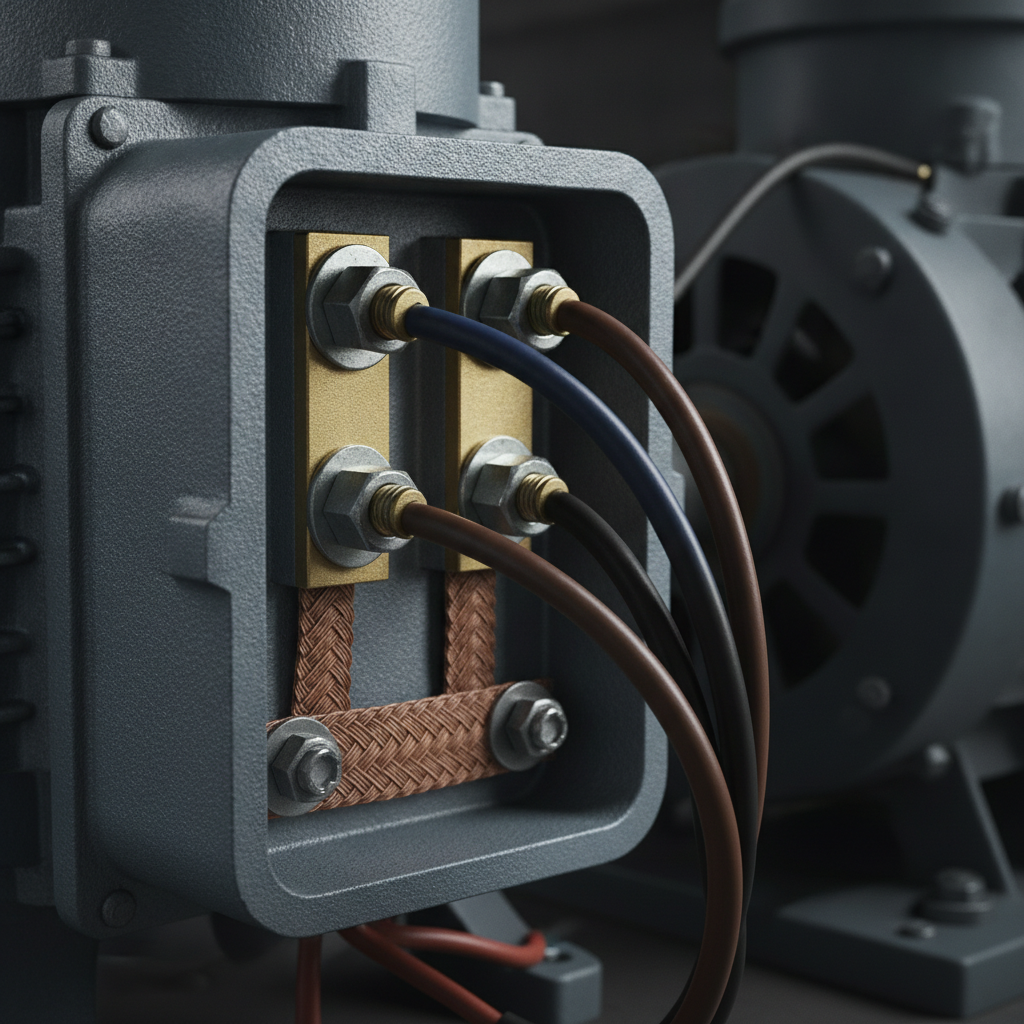
Configurations, Voltages, and Approaches You’ll Encounter
Most facilities use wye (Y) services at 208/120 V or 480/277 V. Some legacy or specialty sites use delta (Δ). Your choice of topology, voltage, and transformer strategy depends on load mix, distance, code requirements, and expansion plans.
These are the practical choices you’ll review with your electrician, utility, or engineer. Each affects conductor size, equipment selection, labeling, and serviceability.
Common service voltages
- 208/120 V wye: common in light commercial; supports standard receptacles and three-phase motors
- 480/277 V wye: favored in larger buildings; 277 V lighting and efficient motor feeders; step down to 208/120 V
- 240 V delta: still seen in legacy shops; watch for the high-leg (≈208 V to neutral) on center-tapped delta
Wye vs delta at a glance
| Attribute | Wye (Y) | Delta (Δ) |
|---|---|---|
| Neutral availability | Yes (line-to-neutral loads) | No (line-to-line only) |
| Typical building use | Offices, retail, mixed loads | Legacy shops, specific motors |
| Common voltages | 208/120 V, 480/277 V | 240 V delta, 480 V delta |
| High-leg considerations | N/A | Labeling and isolation needed |
| Flexibility for receptacles | High | Lower (often needs a transformer) |
Transformer approaches
- Service-level wye with step-down transformers: efficient for long feeders; flexible branch circuits
- Isolation transformers: reduce noise coupling into sensitive electronics
- Buck/boost units: trim small voltage gaps to match equipment nameplates
We size transformers to minimize voltage drop and audible hum, and we place them for safe access and shorter outage windows during service.
Best Practices: Design, Safety, and Maintenance
Plan for growth, label clearly, coordinate protection, and maintain under lockout/tagout. Verified grounding and bonding, thermal scans, and documented studies cut nuisance trips and keep people safe. A disciplined approach turns three-phase into a quiet, scalable backbone.
Good systems look boring on purpose. Labels are clear. Breakers coordinate. Panels run cool. And maintenance windows are short because everything is documented. Here’s how we build that reality.
Design for tomorrow
- Leave realistic headroom in panel and feeder capacity
- Standardize on 480/277 V distribution with step-downs where practical
- Specify VFD-ready motors and harmonic mitigation as needed
- Document one-line diagrams and panel schedules from day one
Safety and compliance
- Apply lockout/tagout and arc-flash labeling; keep single-line diagrams posted
- Use listed equipment with proper SCCR and working clearances
- Test GFCI and verify equipment grounding continuity regularly
- For a deeper dive on protection, see our switchgear testing guide aligned to common standards
Maintenance that matters
- Infrared scans identify hot spots; retorque bus and lugs to spec
- Investigate phase imbalance beyond roughly 2–3%
- Keep panels clean and ventilated; dust traps heat and invites faults
See how these practices fit into our broader service approach on the electrical services page. We adapt cadence to your operations calendar so preventive checks don’t disrupt production.
Tools and Planning Resources
Use data loggers, clamp meters with inrush capture, and power-quality analyzers to size feeders and transformers. Pair measurements with an accurate one-line diagram and equipment list to make upgrades predictable, code-aligned, and fast to maintain.
We approach upgrades like a project, not a guess. Measurements first, drawings second, installation third, and documentation always. Here are the essentials.
Measurement
- Clamp meters with min/max and inrush capture for motor starts
- Three-phase analyzers for THD, flicker, and power factor trends
- Week-long data loggers for true usage profiles before panel work
Documentation
- Current one-line diagram with panel schedules and feeder sizes
- Short-circuit and selective coordination studies for larger sites
- Arc-flash labels aligned to your PPE and training matrix
Low-voltage integration
- Rack power planning for NVRs, PoE switches, and UPS units
- Surge protection on camera runs; proper bonding at outdoor junction boxes
- Neat cable management and wire concealment to protect terminations
For more on installation discipline, see our electrical installation guide and our electrical maintenance checklist. These processes reduce callbacks and make audits simpler.

Mini Case Studies: Real-World Upgrades
Upgrading to three-phase often resolves chronic trips, power-quality complaints, and growth limits. These brief scenarios show how 480/277 V distribution with step-downs, VFDs, and proper labeling stabilize operations, reduce conductor size, and create headroom for expansion.
We selected examples that reflect our hybrid focus—electrical power plus low-voltage reliability—so you can see how decisions upstream affect cameras, networking, and day-to-day operations downstream.
- Light manufacturing shop: Replaced an overloaded single-phase panel with a 208/120 V wye service, added a 30 HP compressor on a VFD, and rebalanced feeder phases. Result: cleaner starts, far fewer breaker trips, and capacity for an extra CNC bay with only minor panel work.
- Office + retail building: Introduced 480/277 V wye service to stabilize elevators and rooftop HVAC, then stepped down to 208/120 V for plugs and tenant improvements. Result: lower feeder currents, simplified lighting, and fewer flicker complaints during elevator cycles.
- Warehouse with cameras: Consolidated PoE switch stacks onto conditioned racks with UPS, powered by a right-sized three-phase panel. Result: no more recorder reboots when large HVAC units start; security footage remained continuous during high load.
- Commercial kitchen: Moved walk-in refrigeration and high-torque mixers to three-phase circuits with soft starts. Result: shorter prep delays, less voltage sag on lighting, and service calls dropped after proper labeling and maintenance scheduling.
Local considerations for your area
- Weather swings stress rooftop gear. Use weather-rated enclosures and schedule preventive checks before peak summer and winter seasons.
- Utility lead times vary by corridor. Start service-change applications early so permits, inspections, and crane work align with your operations calendar.
- Older buildings may have delta or high-leg. Good labeling and a transformer plan protect technicians and simplify future tenant fit-outs.
Frequently Asked Questions
Teams often ask where three-phase is used, how upgrades work, and what voltages to expect. These concise answers cover service availability, motor behavior, and low-voltage effects so you can plan with a licensed electrician.
What is the main advantage of three-phase over single-phase?
Three-phase delivers near-constant power and smoother motor torque, which reduces mechanical stress and nuisance trips. It also carries more power with less copper, so feeders and panels can be smaller for the same load compared with single-phase.
Can a home get three-phase service?
It depends on the local utility and the size of your loads. Some properties near commercial corridors can request it, but many homes stay single-phase and use phase converters or VFDs for specific equipment. A utility check and load study are the first steps.
What voltages are common in commercial buildings?
You’ll most often see 208/120 V wye in light commercial and 480/277 V wye in larger or industrial buildings. Some legacy sites run 240 V delta. Check panel schedules, labels, and equipment nameplates to confirm.
How do VFDs help with three-phase motors?
Variable frequency drives control motor speed and soften starts, reducing inrush and mechanical wear. They also help improve power factor and, with the right filters, can mitigate harmonics that otherwise stress transformers and feeders.
Do low-voltage systems benefit from three-phase?
Indirectly, yes. A stable, right-sized electrical backbone prevents brownouts that can reboot PoE switches or corrupt NVR recordings. We often see camera uptime improve after mains upgrades remove voltage sag from large motor starts.
Conclusion and Next Steps
Three-phase electric power is the foundation for efficient, scalable buildings. If you’re planning HVAC upgrades, new production gear, or more reliable low-voltage racks, a right-sized three-phase design reduces headaches and opens room to grow—safely and in line with code.
Here’s a simple path we follow with clients who want results and minimal disruption:
- Assess existing service, panel loading, and phase balance
- Log current, voltage, and harmonics for a week if needed
- Choose topology (wye vs delta) and voltage class for the load mix
- Plan step-downs, VFDs, labeling, and selective coordination
- Schedule the cutover in a low-impact window; document everything
Explore more ways we reduce downtime in our industrial electrical guide and this operations-focused overview. For small facilities and homes, our residential electrician guide explains safety-first upgrades that scale with your plans.
Key takeaways
- Three-phase delivers smoother torque and higher efficiency than single-phase
- 208/120 V and 480/277 V wye services cover most commercial needs
- Design for growth: capacity, coordination, and clear documentation
- Stable mains improve the reliability of IP cameras, NVRs, and networks
- Load studies and staged cutovers keep operations on track
Want a fast, professional plan? Our certified electricians can meter your site, propose options, and handle the end-to-end upgrade—from utility coordination to final labels and training. Start the conversation on our electrical services page or learn more from our industrial electrician insights.

Industrial Electrician Services: Cut Downtime Fast 2026


CCTV Setup: Protect Your Home and Save Money in 2026
